In Santa Ana, we often see pavements that look sound from the surface but hide subsurface drainage issues or base failures. The city's alluvial soils and seasonal rainfall create conditions where an existing pavement evaluation identifies problems before they cause structural damage. We combine FWD deflection testing with core sampling to assess layer integrity, and when deeper issues are suspected, we coordinate with a calicatas exploratorias program to expose subgrade conditions directly. This approach gives owners a clear picture of remaining service life and necessary repairs.
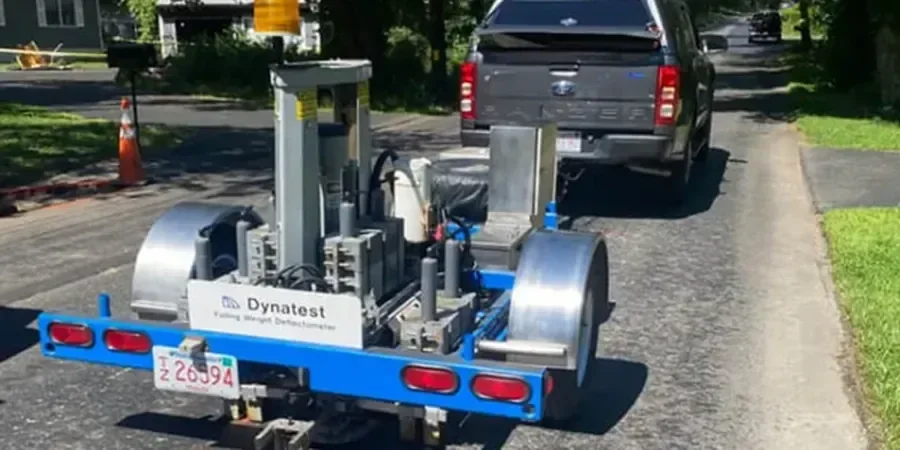
A thorough existing pavement evaluation in Santa Ana can extend service life by 8–12 years while costing a fraction of premature reconstruction.
Scope of work in Santa Ana
- Non-destructive FWD (ASTM D4694) for modulus backcalculation
- Core recovery for thickness verification and lab testing (Hveem, Marshall)
- Pavement condition index (PCI) rating per ASTM D6433
Risks and considerations in Santa Ana
The shallow groundwater table in parts of Santa Ana — sometimes within 2–3 meters of the surface — can cause capillary rise and weaken the subgrade. When this combines with heavy truck traffic on arterials like Bristol Street or Harbor Boulevard, pumping of fines and loss of support accelerate failure. An existing pavement evaluation that omits moisture profiling or drainage assessment often underestimates remaining life. We always include a falling head permeability test (ASTM D5084) on subgrade samples when standing water is observed during coring.
This service complements our laboratory testing work for a complete project analysis.
Our services
We offer two focused services for existing pavement evaluation in Santa Ana:
FWD Deflection Testing & Backcalculation
Using a Falling Weight Deflectometer (FWD) compliant with ASTM D4694, we collect deflection basins at 20–30 m intervals. Backcalculation via ELMOD or MODULUS yields layer moduli for overlay design.
Core Sampling & Laboratory Characterization
Recover 100 mm diameter cores for thickness, binder content, and resilient modulus (ASTM D4123). Includes subgrade classification (ASTM D2487) and CBR testing when required.
Q&A
How long does an existing pavement evaluation take for a typical Santa Ana parking lot?
A standard 10,000 m² lot requires 2–3 days for field work (FWD + coring) and 5–7 business days for lab analysis and reporting. Full report includes PCI rating, deflection profiles, and recommended overlay thickness.
What is the difference between FWD testing and coring?
FWD measures structural capacity by dropping a load and recording deflection — it tells you how the pavement performs under load. Coring gives you physical thickness, binder content, and visual condition of each layer. We always use both together for a complete evaluation.
Do you evaluate concrete pavements (PCC) or only asphalt?
We evaluate both. For concrete pavements in Santa Ana, we use FWD with joint load transfer analysis and core for compressive strength (ASTM C39) and slab thickness. Joint condition, faulting, and dowel alignment are also documented.
How much does an existing pavement evaluation cost in Santa Ana?
Typical costs range between US$1,220 and US$3,360 depending on lot area, number of cores, and whether lab characterization is included. Contact us for a scope-specific quote.