In Santa Ana, the contrast between the alluvial terraces near the Santa Ana River and the older, denser deposits around the Civic Center area often dictates how piles transfer load. Near the river, loose sands and silts dominate the upper 20 to 30 feet, making skin friction along the shaft a primary load-carrying mechanism. Conversely, around downtown, stiffer clay layers and old riverbed gravels can provide substantial end bearing resistance at depth. Understanding this local variability is crucial before committing to a foundation design. We typically begin with a site-specific borehole program and stratigraphic correlation across the site to identify the dominant load-transfer mode, then model both skin friction and end bearing contributions under working and ultimate loads using methods like Meyerhof or the FHWA alpha and beta approaches for clays and sands respectively.
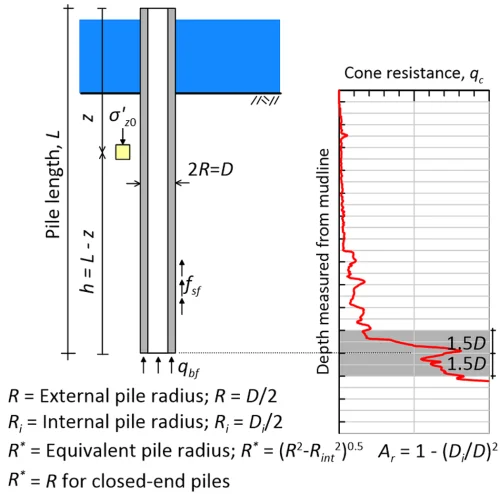
The shallow groundwater in Santa Ana can reduce effective stress on pile shafts by up to 40%, significantly altering the skin friction component in design.
Scope of work in Santa Ana
- We quantify unit skin friction using the beta coefficient method for drained loading and the alpha method for undrained conditions.
- End bearing capacity is assessed using the Meyerhof bearing capacity factors, adjusted for deep foundation geometry.
Risks and considerations in Santa Ana
ASCE 7-16 and IBC 2018 require that pile foundations in Seismic Design Category D (which includes all of Santa Ana) resist both axial and lateral loads with a clear understanding of the load path. The primary risk is over-reliance on end bearing in loose, saturated sands that may liquefy or soften during a seismic event. If the upper 40 feet are susceptible to liquefaction, skin friction in that zone must be neglected entirely, and the pile must develop end bearing in competent strata below. We follow the NCEER (Youd and Idriss, 2001) liquefaction evaluation procedure and apply the Idriss and Boulanger (2008) cyclic resistance ratio adjustments to ensure that the pile's load-transfer mechanism is earthquake-resilient.
This service complements our laboratory testing work for a complete project analysis.
Our services
We provide a complete suite of pile skin friction vs. end bearing analysis services tailored to Santa Ana's subsurface conditions. Each analysis includes field testing, laboratory characterization, and numerical modeling of shaft and base resistance.
Site-Specific SPT and CPT Investigation
Boreholes with SPT at 5-ft intervals, energy correction, and CPT soundings to measure cone tip resistance and sleeve friction for direct skin friction and end bearing parameters.
Laboratory Strength and Index Testing
Triaxial CU and UU tests on intact samples, direct shear on sand, and Atterberg limits on clay to calibrate alpha and beta coefficients for skin friction.
Load-Transfer Analysis and Settlement Modeling
Finite element or load-transfer (t-z, q-z) analysis separating shaft and base resistance under service and ultimate loads, including group effects.
Seismic Liquefaction and Skin Friction Reduction Assessment
Evaluation of liquefaction potential per NCEER and ASCE 7, including reduction or full exclusion of skin friction in liquefiable layers.
Q&A
What is the difference between skin friction and end bearing in pile design?
Skin friction is the load transferred along the pile shaft through shear resistance between the pile surface and surrounding soil. End bearing is the load transferred at the pile tip through bearing on a competent soil or rock layer. In Santa Ana, the relative contribution of each depends strongly on the soil profile: loose alluvium near the river favors skin friction, while stiffer old deposits downtown can provide significant end bearing.
How much does a pile skin friction vs. end bearing analysis cost in Santa Ana?
The cost for a complete analysis including field SPT borings, lab testing, and numerical modeling typically ranges from US$1.050 to US$3.190, depending on the number of borings, depth, and complexity of the soil profile. Additional costs may apply for CPT soundings or seismic assessments.
Why is skin friction more critical in Santa Ana's alluvial soils?
Santa Ana's alluvial soils often consist of loose to medium-dense sands and soft clays in the upper 30 to 40 feet. In these profiles, end bearing at shallow depths is unreliable because the soil lacks sufficient strength or is prone to liquefaction. Skin friction along the shaft becomes the dominant load-transfer mechanism, provided the shaft is designed to mobilize the available shear resistance without excessive settlement.
What standards govern pile skin friction and end bearing analysis in Santa Ana?
The analysis must comply with IBC 2018 Chapter 18, ASCE 7-16 for seismic design, and ASTM D1586 for SPT procedures. The FHWA GEC 10 (O'Neill & Reese, 1999) is the industry reference for drilled shaft design, providing alpha and beta methods for skin friction and Meyerhof's method for end bearing. Local practice also follows the NCEER guidelines for liquefaction evaluation.