Santa Ana sits on a geologically young alluvial plain, where clay-rich layers from the Santa Ana River floodplain mix with older terrace deposits. In practice, these fine-grained soils often exhibit moderate to high plasticity — meaning they swell when wet and shrink during dry spells. The team here sees this pattern repeatedly in residential blocks near the 5 freeway and in older neighborhoods east of downtown. An expansive soil evaluation in Santa Ana starts with Atterberg limits and free-swell tests under ASTM D4318, paired with a corte directo to measure shear strength changes after wetting. Without these tests, a slab-on-grade floor can crack within two seasonal cycles.
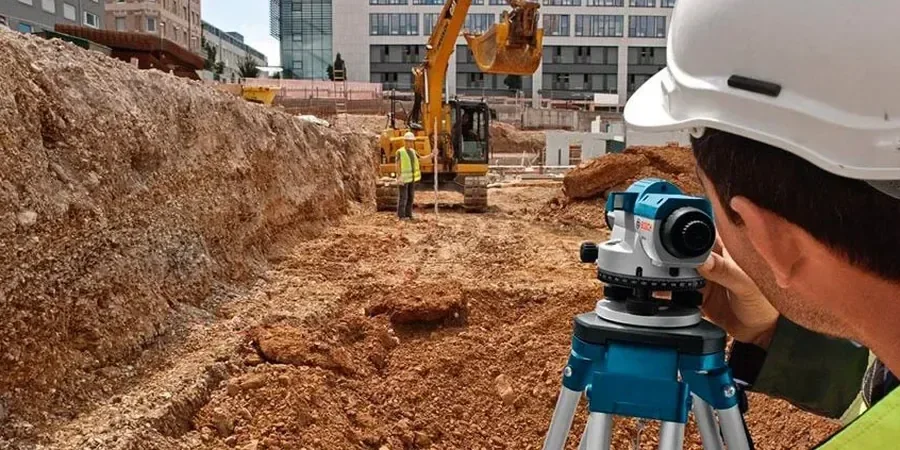
Soils with a plasticity index above 25 and fines content over 50% are classified as highly expansive — a condition common in Santa Ana's alluvial clays.
Scope of work in Santa Ana
Risks and considerations in Santa Ana
Santa Ana expanded rapidly after World War II, with tracts built on former agricultural land that was flood-irrigated for decades. Those old irrigation practices left deep desiccation cracks, and new construction often placed fill over uncompressed native clay. The result: differential heave at building corners, cracked driveways, and tilted porch slabs. An expansive soil evaluation in Santa Ana catches these risks before the foundation is poured. The same clays that swell can also collapse under load if not properly compacted, a dual hazard that demands both swell testing and a compresion simple on undisturbed samples to confirm unconfined strength.
This service complements our laboratory testing work for a complete project analysis.
Our services
Our laboratory offers a complete suite of tests tailored to expansive soils in Santa Ana. Each service follows ASTM standards and is performed by experienced technicians.
Atterberg Limits & Plasticity Classification
Determination of liquid limit, plastic limit, and plasticity index on disturbed samples. Classifies the soil as low, medium, or high expansion potential per USCS and AASHTO.
One-Dimensional Swell/Collapse Test
Measures percent swell and swell pressure under controlled surcharge loads (1 to 10 psf). Results guide foundation slab depth and void space design.
Moisture-Density Relationship (Proctor)
Standard and modified Proctor compaction tests to determine optimum moisture content and maximum dry density. Essential for fill placement in expansive soil zones.
Q&A
How much does an expansive soil evaluation in Santa Ana cost?
A typical evaluation including Atterberg limits, free-swell test, and compaction report ranges from US$550 to US$1.640 depending on the number of samples and depth of borings. Additional tests like swell pressure or triaxial shear add to the final cost.
What plasticity index indicates high expansion potential?
Soils with a plasticity index above 25 are classified as highly expansive under the Unified Soil Classification System. In Santa Ana, many clay layers show PI values between 25 and 35, which triggers special foundation design per IBC Chapter 18.
Can I build a slab-on-grade on expansive soil in Santa Ana?
Yes, but only if the slab is designed as a stiffened or post-tensioned slab on grade per PTI DC10.1 or IBC 1808.9. The design must use the measured swell pressure and percent swell from lab tests to avoid edge-lift cracking.
What is the difference between free swell and swell pressure?
Free swell measures the percent volume increase of a soil sample when allowed to expand without any load. Swell pressure measures the stress required to prevent that expansion. Both are needed for foundation design: free swell tells you how much movement to expect, swell pressure tells you how much load the foundation must resist.