Santa Ana's transformation from a ranching hub into Orange County's urban core created a patchwork of fill layers and variable alluvial soils. Much of downtown rests on old river deposits from the Santa Ana River, while residential tracts sit on compacted agricultural loams. Engineers planning new foundations or pavement sections need to know how those soils will behave under compaction. That's where the Proctor test comes in. This standard laboratory procedure determines the optimum moisture content and maximum dry density for a given soil, establishing the compaction target for earthwork. For projects in Santa Ana, understanding these values early prevents settlement issues later. The test follows ASTM D698 for standard effort or ASTM D1557 for modified effort, depending on the expected loading.
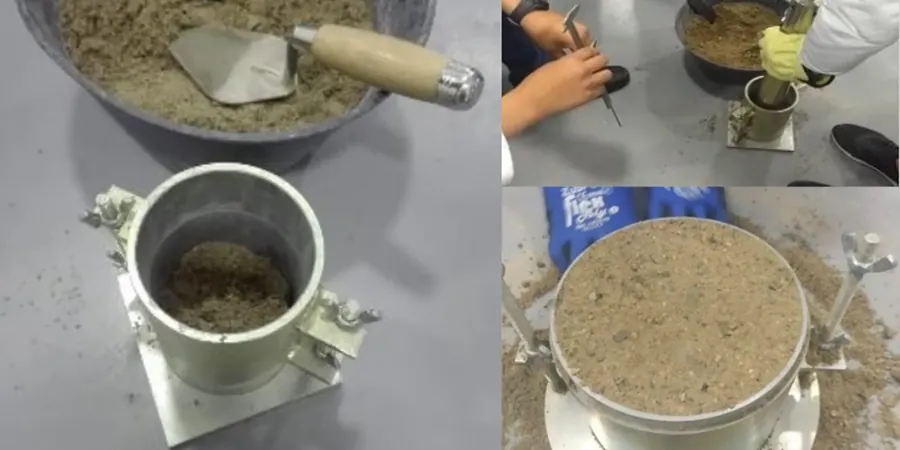
A single Proctor curve tells you the exact moisture window where soil achieves its densest state — miss it and settlement risk climbs sharply.
Scope of work in Santa Ana
Risks and considerations in Santa Ana
A strip mall project near Bristol Street once used fill compacted at 8% moisture content — well below the optimum determined by a Proctor test. Within two years, the pavement developed differential settlement of nearly 3 inches. The soil had not reached its maximum density, so it continued to consolidate under traffic loads. That scenario repeats when contractors skip or rush the Proctor test, assuming generic values apply. For Santa Ana's mixed geology, each borrow source or cut area produces a different compaction curve. Without site-specific data, the risk of post-construction settlement, slab cracking, and utility line damage increases substantially.
This service complements our laboratory testing work for a complete project analysis.
Our services
We offer Proctor testing tailored to Santa Ana's soil conditions, with quick turnaround for both standard and modified methods.
Standard Proctor Test (ASTM D698)
For light to moderate compaction requirements, such as residential slabs, sidewalks, and parking lots. Uses 5.5 lb hammer, 12-inch drop, three layers.
Modified Proctor Test (ASTM D1557)
For high-traffic pavements, airport runways, and heavy structural fills. Uses 10 lb hammer, 18-inch drop, five layers. Required by Caltrans for state projects.
Compaction Curve Analysis & Reporting
Includes graphical plot of dry density vs. moisture content, calculation of optimum moisture and maximum dry density, plus comparison with project specifications.
Q&A
What is the difference between Standard and Modified Proctor tests?
The Modified Proctor applies about 4.5 times more compactive energy per unit volume than the Standard Proctor. Modified is used for heavy loads like highways and airfields, while Standard suits lighter applications like residential fill.
How much does a Proctor test cost in Santa Ana?
Typical pricing for a single Proctor test ranges from US$110 to US$180, depending on whether it is Standard or Modified and how many moisture points are run. Volume discounts apply for multiple samples.
How long does it take to get results?
A standard Proctor test requires about 24 to 48 hours for sample preparation, compaction, moisture determination, and curve plotting. Modified tests may take slightly longer due to the extra layers.
Do I need a Proctor test for a small retaining wall in Santa Ana?
Yes, if the wall requires engineered backfill. The Proctor test sets the compaction target for the fill material behind the wall, preventing future settlement or lateral movement. Check with your structural engineer.
Can you test soil from different depths or borrow pits separately?
Absolutely. Each distinct soil type or borrow source needs its own Proctor curve. Mixing different soils into one test produces an unreliable target. We recommend one test per material type or per 500 cubic yards of fill.