Santa Ana's rapid post-war expansion turned citrus groves into dense residential blocks. That history matters. The city sits on alluvial fans from the Santa Ana Mountains, with sandy loams overlying clay layers. Stormwater runoff here is intense during winter rains. Poor drainage shortens road life fast. Before any resurfacing or widening project, we assess subsurface flow paths. A targeted investigation links surface hydrology with soil permeability. That is why we combine Vial with permeability testing to predict how water moves under asphalt. Getting this wrong means cracked pavements within two seasons. Our team has seen it happen.
Drainage design that ignores Santa Ana's alluvial layering guarantees pavement failure within two to three rainy seasons.
Scope of work in Santa Ana
Risks and considerations in Santa Ana
Santa Ana lies in a seismically active region, but the real day-to-day threat is water. The historical floodplain of the Santa Ana River extends under much of the city. Shallow groundwater rises during El Nino events. When that water saturates the subgrade, pavement loses support. We have measured CBR drops of 60% after a wet winter. The second risk is undocumented fill. Old orchards were leveled with random debris. That fill settles unevenly when wetted. A proper drainage assessment must include test pits to verify subgrade condition before any design work begins.
This service complements our laboratory testing work for a complete project analysis.
Our services
We offer four integrated services for road drainage projects in Santa Ana. Each addresses a specific phase of the subsurface investigation.
Subsurface Permeability Testing
Field falling-head and constant-head tests per ASTM D3385. We measure in-situ hydraulic conductivity at multiple depths. Data feeds directly into drainage layer design and subdrain spacing calculations.
Groundwater Monitoring & Piezometers
Installation of standpipe piezometers to track seasonal water table fluctuations. Continuous logging over at least one wet season provides reliable data for hydrostatic pressure analysis on retaining walls and pavements.
Subgrade CBR & Compaction Control
Laboratory and field CBR tests (ASTM D1883) on undisturbed and remolded samples. We correlate results with Proctor compaction curves to specify optimum moisture and density for road subgrades.
Geotextile & Drainage Layer Design
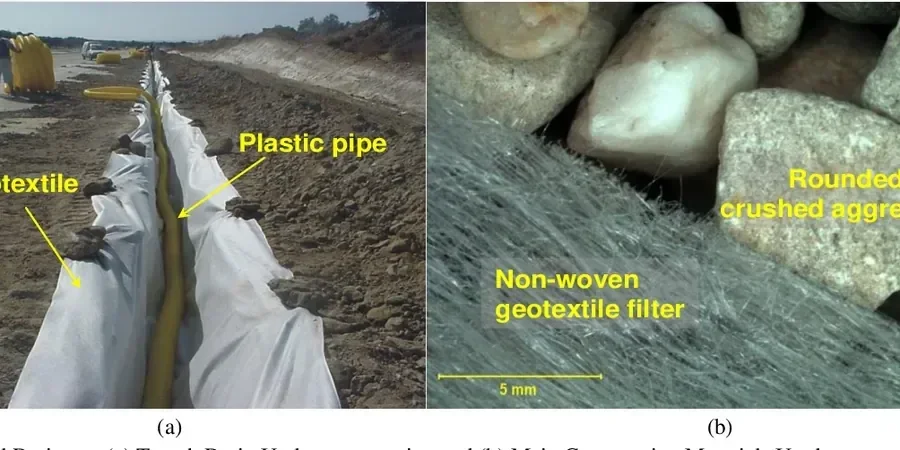
Selection of nonwoven geotextiles for separation and filtration. We specify aggregate gradation and layer thickness based on soil retention criteria and flow capacity under AASHTO M 288.
Q&A
What is the typical cost range for a geotechnical road drainage study in Santa Ana?
For a standard collector road or subdivision project, the investigation runs between US$800 and US$2,540. The range depends on the number of test pits, permeability tests, and laboratory analyses required.
How deep should I dig test pits for drainage evaluation?
Test pits should extend at least 1.5 m below the proposed subgrade elevation. In Santa Ana's alluvial soils, deeper pits may be needed to identify perched water tables or buried organic layers.
Do I need a drainage study for a simple road overlay?
Yes, if the existing pavement shows cracking or pumping. An overlay on a saturated subgrade fails prematurely. A quick permeability test and two CBR samples can save thousands in repairs.
What soil conditions in Santa Ana most affect drainage design?
The main challenge is the alternating sand-clay sequence. Sandy layers drain fast but can cause piping. Clay lenses trap water and create perched conditions. We map these layers with continuous soil sampling.