Santa Ana sits at an elevation of 100 feet above sea level, with a semi-arid climate that produces silty sands and clay-rich alluvial deposits from the Santa Ana River. These soils shift in composition within a single block, making a precise geogrid specification essential for road bases, retaining walls, and slope reinforcement. Before writing a specification, we perform site-specific soil classification and adjust for the expected traffic loads or retained earth pressures. A well-defined geogrid specification prevents differential settlement and extends pavement life, especially when combined with a geotextile separator beneath the base course. The city's seismic zone, classified as moderate per ASCE 7, also demands that the geogrid elongation at peak strength stays under 5% to resist dynamic loading without excessive deformation.
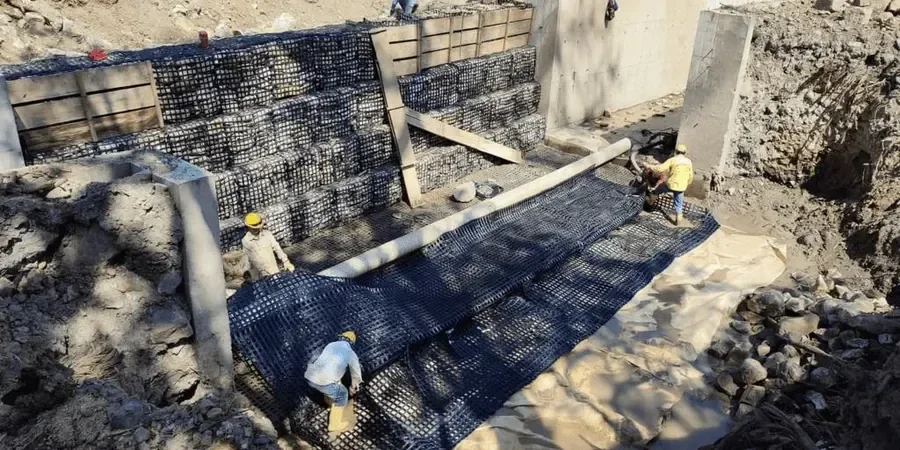
A correct geogrid specification starts with subgrade strength, not a catalog. Without it, the reinforcement layer may never engage.
Scope of work in Santa Ana
Risks and considerations in Santa Ana
Santa Ana’s rapid development since the 1950s converted floodplains and agricultural fields into residential subdivisions and commercial corridors. Many older fills were placed without compaction control, creating zones of low density that settle unevenly under new loads. When a geogrid specification ignores these variable fill layers, the reinforcement may not engage at the design strain, leading to pavement cracking or wall face bulging. The city’s seismic history—with the 1933 Long Beach earthquake causing widespread liquefaction in similar alluvial soils—reinforces the need for a specification that accounts for peak ground acceleration and the potential for lateral spreading near the river channel.
This service complements our laboratory testing work for a complete project analysis.
Our services
Our geogrid specification services in Santa Ana include two main offerings that cover the full project cycle from design to construction support.
Design‑Phase Geogrid Specification
We analyze soil borings, traffic loads, and seismic parameters to write a tailored specification that defines geogrid type (biaxial, triaxial, or uniaxial), tensile strength, aperture size, and placement depth. We also prepare a construction drawing showing layer layout and overlap requirements.
Construction Quality Assurance for Geogrid Installation
Our technicians verify that the delivered geogrid matches the specified tensile properties and that the installation follows the approved plan—checking overlap widths, anchorage at wall faces, and coverage before aggregate placement. We issue a signed QA report for the project record.
Q&A
What is the typical cost range for a geogrid specification report in Santa Ana?
For a standard project (one to two reinforcement layers over 5,000–10,000 square feet), the specification report ranges between US$390 and US$1,200. The final cost depends on the number of soil samples, the complexity of the loading conditions, and whether seismic design checks are required.
How does Santa Ana's soil type affect the geogrid specification?
Santa Ana's alluvial silts and clays often have a soaked CBR below 3. That low subgrade strength forces the use of a triaxial geogrid with a higher aperture stability modulus to prevent aggregate punch‑through. We also specify a geotextile separator when the subgrade is saturated.
Can the same geogrid specification be used for a retaining wall and a pavement section?
No. Retaining walls require a uniaxial geogrid with a long‑term design strength based on creep and pullout resistance, while pavements need a biaxial or triaxial grid optimized for confinement at low strain. We write separate specifications for each application.