The difference between the flat alluvial deposits near the Santa Ana River and the steeper slopes of Loma Ridge tells you a lot about local soil behavior. On the river side, we see deep fine sands and silts that shift under load. Up in the hills, it’s colluvium over weathered sedimentary rock. That contrast means a single foundation approach rarely works. For embankments and retaining structures across both zones, we rely on geocell design to distribute loads laterally and reduce differential settlement. Before locking in the geometry, we always run a granulometría on site soils to match cell aperture with particle size.
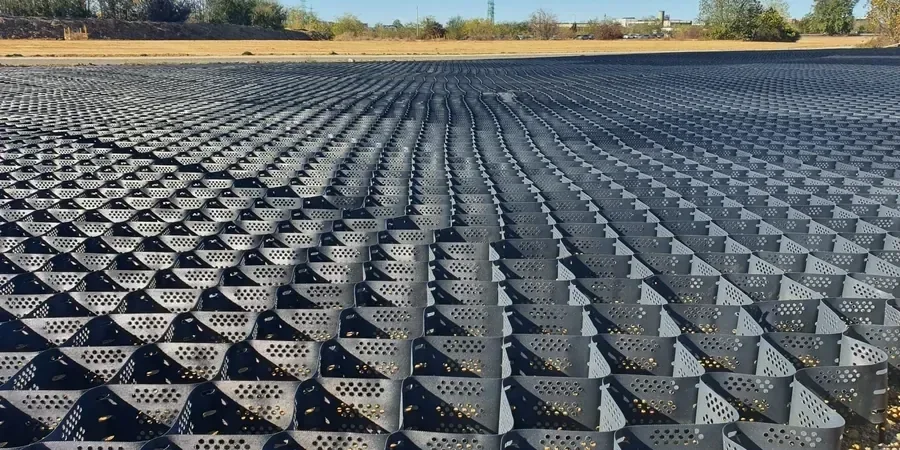
Geocell design in Santa Ana must account for undocumented fills from the 1960s expansion, often missed by standard borings.
Scope of work in Santa Ana
- Steep slope armoring on cut slopes off the 55 freeway
- Load transfer layers over soft clay lenses in commercial lots
- Erosion control on drainage swales near the Civic Center
Risks and considerations in Santa Ana
IBC Chapter 18 and ASCE 7 classify much of Santa Ana as Seismic Design Category D, which means we have to check liquefaction potential even for shallow reinforced soil layers. Loose saturated sands under the water table can trigger settlement during shaking. A geocell design that ignores this risk may perform well under static loads but fail in a moderate earthquake. We run cyclic triaxial tests on representative samples and set the cell confinement pressure high enough to suppress pore pressure buildup. That extra step has saved clients from costly post-seismic repairs in older commercial parks near the river.
This service complements our laboratory testing work for a complete project analysis.
Our services
Our geocell design work breaks into four service lines to cover the full project cycle.
Slope stabilization with geocell
Design and detailing of geocell-reinforced soil slopes for cuts and fills up to 1H:1V, including drainage layer specification and toe anchor sizing.
Load transfer platforms for shallow foundations
Geocell base layer design under spread footings or slab-on-grade on soft subgrade (CBR < 3), with settlement verification per elastic theory.
Erosion control channel linings
Hydraulic design of geocell-lined swales and ditches for velocities up to 6 m/s, infilled with riprap or vegetated topsoil.
Retaining wall backfill reinforcement
Geocell panels placed behind MSE or gravity walls to reduce lateral earth pressure and improve drainage, designed per AASHTO LRFD.
Q&A
What is the main advantage of geocell design over conventional reinforcement?
Geocell confinement increases the apparent cohesion of granular fills, allowing steeper slopes and thinner base layers without geotextile separation. It also distributes concentrated loads over a wider area, reducing bearing pressure on weak subgrades.
How much does a geocell design study typically cost in Santa Ana?
For a standard commercial lot (1–2 acres), the engineering design including lab testing and report runs between US$840 and US$2,620, depending on the number of cross-sections and infill material variability.
Do Santa Ana soils require special geocell infill materials?
Alluvial sands near the river are well-graded and work fine as infill. On the hillside colluvium, we often blend in 20% crushed aggregate to improve internal friction. We test the infill gradation per ASTM D422 before finalizing the design.
Can geocell design be used in seismic retrofit applications?
Yes. We have designed geocell wraps around existing shallow footings in Santa Ana to improve lateral confinement. The key is matching the cell stiffness to the expected peak ground acceleration (0.4–0.6g per ASCE 7) so the soil doesn't soften during shaking.