A common mistake contractors make in Santa Ana is assuming shallow footings work everywhere. The alluvial soils near the Santa Ana River change abruptly a few blocks away. You hit stiff clay in one lot and loose sand with groundwater at three feet in the next. Pile foundation design in Santa Ana has to account for that lateral variability. Without a proper subsurface investigation, you risk differential settlement or even bearing failure. That is why we always start with a site-specific boring program. Before designing deep foundations, we run field tests such as the standard penetration test to identify weak zones and groundwater levels.
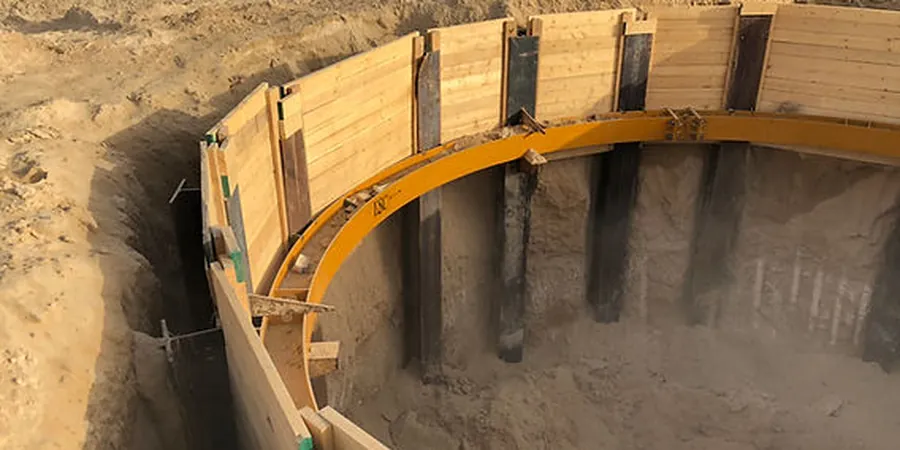
In Santa Ana, pile design is less about capacity and more about lateral resistance — seismic loads drive the pile spacing and reinforcement.
Scope of work in Santa Ana
Risks and considerations in Santa Ana
Compare the soil near South Coast Metro with what you find west of Harbor Boulevard. On the east side, old river deposits give you medium-dense sands with good friction. West of Harbor, you hit soft clay layers up to 20 feet thick. Pile foundation design in Santa Ana must handle that contrast. If you design for the east side conditions and build on the west, your piles may not develop enough skin friction. Add a seismic event and you get liquefaction in the loose sands below the clay. That is why we always check the NCEER liquefaction triggering curves before finalizing pile depths.
This service complements our laboratory testing work for a complete project analysis.
Our services
We offer two complementary approaches for pile foundation design in Santa Ana, depending on the soil profile and structural loads.
Driven precast concrete piles
Precast piles driven to refusal in dense sand or weathered bedrock. Suitable for medium- to high-rise buildings in Santa Ana where access allows pile driving rigs. We design the hammer energy, cushion, and pile cap connections per ACI 543R.
Auger cast (CFA) piles
Continuous flight auger piles installed without casing in cohesive soils. Great for residential and light commercial projects in Santa Ana where noise and vibration must stay low. We verify grout volume and reinforcement spacing during installation.
Q&A
What soil conditions in Santa Ana require piles instead of shallow footings?
Soft clays, loose sands with groundwater within 10 feet, and fill layers deeper than 5 feet all justify deep foundations. In Santa Ana, the old river channel deposits create variable profiles where spread footings would settle unevenly.
How much does pile foundation design cost in Santa Ana?
The typical range for a full design package including soil report and structural calculations is between US$1,770 and US$5,490. Final cost depends on the number of load cases, pile types considered, and site access conditions.
Do seismic zones in Santa Ana affect pile spacing?
Yes. Because Orange County sits in seismic zone 4, lateral loads often govern pile group spacing. You need minimum center-to-center distances of 2.5 to 3 pile diameters to avoid group efficiency loss under cyclic loading.