When we start a project in Santa Ana, the first thing we notice is the variability in alluvial deposits from the Santa Ana River floodplain. An exploratory test pit gives us direct access to the soil profile, something you just don't get with boreholes alone. We dig down to 4.5 meters typically, logging every layer by color, texture, and moisture. This method is especially useful when we need to verify bearing strata for shallow footings or to assess the presence of undocumented fill. In many cases, we combine this with a drenaje vial study to understand how groundwater might affect excavation stability.
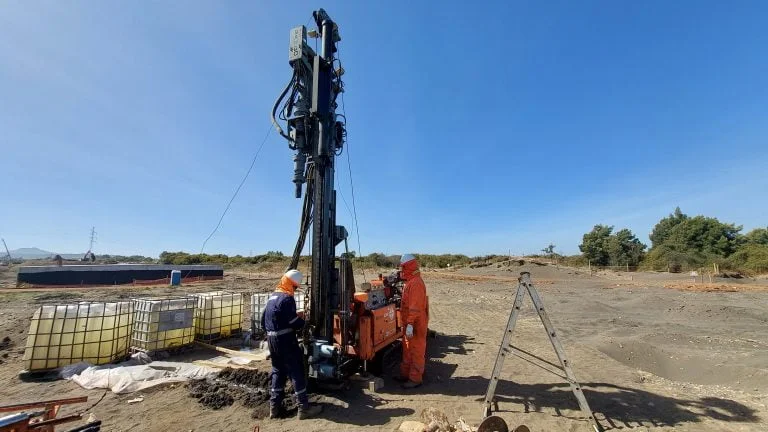
A single test pit can reveal undocumented fill or perched water that no geophysical survey will catch. That visual confirmation is irreplaceable.
Scope of work in Santa Ana
- Logging per ASTM D2488 for visual-manual description
- Sampling for moisture content, dry density, and Atterberg limits
- Field pocket penetrometer readings every 0.3 m
Risks and considerations in Santa Ana
The biggest mistake we see in Santa Ana is relying solely on SPT borings without a single test pit. Borings can miss thin clay seams or gravel lenses that control bearing capacity. One contractor we worked with started a retaining wall foundation based on N-values only, and hit a 0.6 m soft clay layer at 2 m depth that the boring had skipped. An exploratory test pit would have caught that. We always recommend at least one pit per parcel in residential subdivisions to confirm the subsurface model before concrete is poured.
This service complements our laboratory testing work for a complete project analysis.
Our services
Our exploratory test pit service in Santa Ana covers the full scope of shallow investigation. We handle everything from permitting to backfill compaction.
Full Test Pit Excavation and Logging
We coordinate with utility locators, excavate to target depth using a rubber-tracked backhoe, and log the soil profile in 0.3 m intervals per ASTM D2488. Photos and GPS coordinates are included in the report.
Disturbed and Undisturbed Sampling
Bulk samples for classification and compaction are collected from each stratum. Thin-walled tube samples are taken in cohesive soils for triaxial or consolidation testing.
Field Density and Moisture Verification
After backfill, we perform nuclear gauge or sand cone density tests to verify compaction meets project specifications. Results are reported within 24 hours.
Q&A
What is the typical depth of an exploratory test pit in Santa Ana?
We routinely excavate to 4.5 m depth, limited by shoring requirements and groundwater conditions. In the Santa Ana River floodplain, we often stop at 3 m due to shallow water table. The pit is always benched or sloped per OSHA regulations.
How much does an exploratory test pit cost in Santa Ana?
For a standard pit to 4.5 m depth with logging and bulk sampling, the cost ranges from US$550 to US$870. This includes mobilization within 15 miles, one technician on site, and a preliminary field log. Additional testing or deeper pits may increase the price.
What soil conditions are common in Santa Ana that a test pit reveals?
Santa Ana has alluvial sand and silty clay layers with variable gravel content. Old river channels can leave loose sand pockets or stiff clay lenses. A test pit lets us see the actual stratification, identify undocumented fill, and check for perched water before foundation design.