In‑situ testing in Santa Ana provides direct measurement of soil and rock properties without disturbing the ground’s natural state, essential given the region’s alluvial basins and variable compressible layers. These investigations follow ASTM and Caltrans standards to capture conditions that lab tests alone cannot replicate. Common methods include the field density test (sand cone method) for compaction control and the field permeability test (Lefranc/Lugeon) to assess water flow through coarse‑grained soils or fractured rock.
Infrastructure, commercial, and stormwater infiltration projects routinely demand this data for foundation design, percolation analysis, and earthwork verification. When intact specimens are needed for strength and consolidation testing, crews pair field trials with undisturbed sampling (Shelby tube) to preserve soil fabric. The category thus links direct measurements and high‑quality retrieval, giving engineers reliable parameters for safe, code‑compliant construction across Orange County.
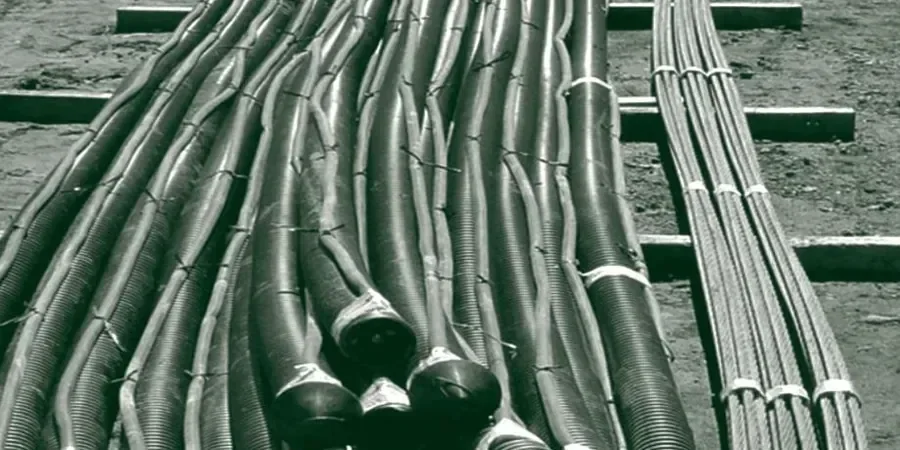
Active anchors generate their own load, passive anchors resist it; knowing which one fits Santa Ana’s deposits is the difference between a secure wall and a progressive failure.
Scope of work in Santa Ana
Risks and considerations in Santa Ana
The greatest risk for anchor systems in Santa Ana is the presence of undocumented fill and loose granular deposits from historical agricultural land use. When a drill rig encounters a buried layer of uncompacted sand or old organic debris, the grout takes an unpredictable path, reducing bond capacity. For active anchors, the lock-off load can induce excessive creep if the bonded zone sits in a creeping soil. For passive anchors, the lack of initial tension means the system only activates after movement begins, which can be problematic in seismic events where displacements are rapid. We always verify the soil profile with a test anchor loaded to 1.5 times the design load, and we require proof testing for every production anchor in Santa Ana.
This service complements our laboratory testing work for a complete project analysis.
Our services
We offer two specialized anchor design services tailored to Santa Ana’s subsurface conditions.
Active Anchor Design
Permanent and temporary post-tensioned anchors for retaining walls, tieback walls, and slope stabilization. Includes lock-off load verification, corrosion protection design, and proof testing in accordance with PTI DC35.1.
Passive Anchor Design
Grouted anchors for foundation uplift resistance, MSE wall facing connections, and temporary excavation support. Designed with conservative bond lengths and verified through pullout tests to confirm capacity.
Q&A
What is the difference between an active and a passive anchor in geotechnical design?
An active anchor is post-tensioned after installation to apply a preload to the soil or rock mass, creating a compressive zone that resists movement. A passive anchor is grouted in place with no initial tension; it only resists load when the structure begins to move. In Santa Ana, active anchors are favored for permanent retaining walls where displacement control is critical, while passive anchors are used for temporary applications or where the structure can tolerate minor movement.
How much does anchor design typically cost for a project in Santa Ana?
The cost for anchor design services in Santa Ana usually ranges between US$1,060 and US$3,390, depending on the number of anchors, the complexity of the soil profile, and the need for test anchors. This includes design calculations, shop drawings, and specification of corrosion protection. Final pricing is confirmed after the geotechnical investigation is reviewed.
What soil conditions in Santa Ana affect anchor capacity the most?
Loose alluvial sands and silty clays with high plasticity are the most common problematic deposits. These soils can exhibit low skin friction and high creep rates, especially under sustained load. We recommend performing a test anchor program to verify bond capacity when these conditions are encountered, as design assumptions based on general correlations may not be conservative.
What corrosion protection is required for permanent anchors in Santa Ana?
For permanent anchors, dual corrosion protection (DCP) is standard, consisting of a continuous plastic sheath over the bonded length and a greased or encapsulated unbonded length. This is required by PTI DC35.1 and recommended by the City of Santa Ana building department for anchors installed in aggressive soils with low resistivity or high chloride content.