IBC Chapter 18 and ASCE 7-22 both require that foundations be designed to limit differential settlement to tolerable values, and in Santa Ana this is especially critical given the region's deep alluvial deposits and variable groundwater levels. The city sits on Quaternary-age sediments that can exhibit both immediate elastic compression and long-term consolidation under load. We perform settlement analysis using one-dimensional consolidation theory (ASTM D2435) and elastic settlement methods, with field data from SPT borings and undisturbed sampling to capture the actual stress history of each stratum. Before any slab or footing is placed, we correlate N-values with constrained modulus (Mv) and run at least two loading increments to verify the preconsolidation pressure profile. This approach has proven reliable for commercial pads and residential tracts across Santa Ana's floodplain soils.
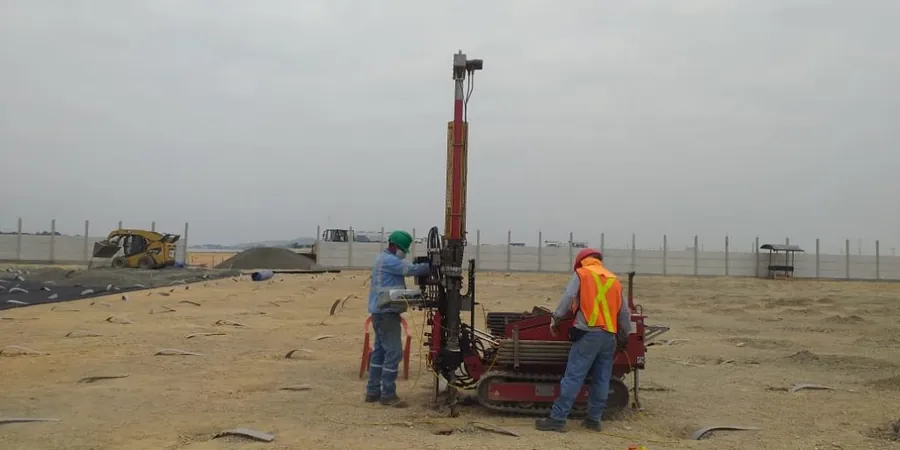
We isolate preconsolidation pressure from oedometer data and run time-rate curves so contractors know exactly when to pour slabs after loading.
Scope of work in Santa Ana
Risks and considerations in Santa Ana
A 15-story apartment tower near 1st and Main in Santa Ana was recently redesigned after our preliminary settlement analysis showed nearly 4 inches of total settlement under the mat foundation. The client had originally planned a shallow spread footing system, but the presence of 30 feet of soft clay over dense sand produced differential settlements that would have cracked shear walls and jammed elevator shafts. By running consolidation tests on undisturbed tube samples from three different depths, we identified a preconsolidated crust at 12 feet that could carry the load if the mat was thickened and the excavation was preloaded. We recommended a surcharge program with settlement platforms to verify field behavior before permanent construction began, avoiding a retrofit that would have cost more than the entire geotechnical program.
This service complements our laboratory testing work for a complete project analysis.
Our services
We tailor settlement analysis to Santa Ana's stratigraphy with three core service lines:
One-Dimensional Consolidation Testing
Oedometer tests on undisturbed Shelby tube samples to obtain Cc, Cr, Cv, and Pc. We run at least five loading increments per test and report time-settlement curves for each load step.
Elastic Settlement Modeling
Using Schmertmann's strain influence method and elastic modulus correlations from SPT N-values and CPT tip resistance. We model both square footings and continuous strip footings for typical Santa Ana commercial buildings.
Differential Settlement Risk Assessment
We compute angular distortion and relative rotation for every column pair, then compare results against IBC Table 1806.1 limits for framed structures and tilt-up panels common in Orange County.
Q&A
How long does a settlement analysis typically take in Santa Ana?
A standard consolidation test run with five load increments takes 7 to 10 days from sample receipt, plus 2 days for elastic settlement modeling and report writing. If we need to air-dry or trim high-sensitivity clays, add 2 more days. We can expedite to 5 business days with a rush surcharge.
What is the difference between total settlement and differential settlement in a foundation?
Total settlement is the absolute downward movement of a single footing, while differential settlement is the difference in movement between two adjacent footings or between two points on a mat. IBC 2021 limits differential settlement to 1/300 of the span between columns for most structures. Cracks in walls and floors are almost always caused by differential, not total, settlement.
How much does a settlement analysis cost in Santa Ana?
A complete settlement analysis including three oedometer tests, elastic modeling, and a report with time-rate curves typically ranges between US$580 and US$1,440 for a standard residential or small commercial project. The final price depends on the number of samples tested, the depth of boring required, and whether we need to run secondary compression or swelling tests.