Many contractors in Santa Ana assume uniform soil conditions across the valley, but the geological profile here is far from simple. Between the Santa Ana River floodplain deposits and the older alluvial fans from the Santiago Creek, bearing capacities can vary by 1.5 to 3 ksf within a single lot. Skipping a proper soil mechanics study before foundation design often leads to differential settlement cracks in slab-on-grade homes. We have seen projects where the geotechnical report was bypassed, and within two years the garage slab had dropped over an inch. A thorough investigation, including borehole drilling and SPT, is the only way to map these transitions accurately before pouring concrete.
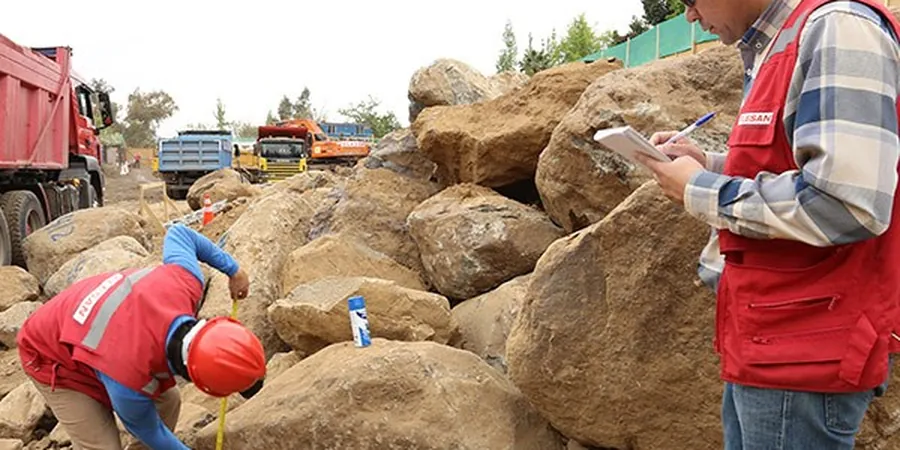
Bearing capacities in Santa Ana vary by up to 3 ksf across a single lot — a soil mechanics study maps that risk before foundation design begins.
Scope of work in Santa Ana
- Boring logs with N-values at 1.5-ft intervals
- Water table observations over 72 hours
- Atterberg limits on fine-grained layers
- Expansion index (ASTM D4829) for clay lenses
Risks and considerations in Santa Ana
The biggest risk we see in Santa Ana is the presence of undocumented fill from old agricultural grading. These fills can be 3 to 8 feet thick, with highly variable compaction. If you drive a test pit or shallow boring through this layer, the N-values can be as low as 3 blows/ft. Building a spread footing directly on that material without a soil mechanics study means the footing will settle unevenly within months. We always flag these zones and recommend removal and recompaction or deep foundation alternatives like driven piles. The cost of the study is trivial compared to a $60,000 slab repair.
This service complements our laboratory testing work for a complete project analysis.
Our services
Our soil mechanics study covers the full spectrum of in-situ and laboratory testing needed for Santa Ana conditions.
Standard Penetration Test (SPT) Borings
Hollow-stem auger borings to depths of 40 feet with SPT sampling at 5-ft intervals. Continuous split-spoon samples for visual classification and moisture content.
Laboratory Testing Package
Grain-size distribution (wash sieve), Atterberg limits, natural moisture, and unconfined compression on cohesive layers. Results processed within 5 business days.
Q&A
How long does a soil mechanics study take in Santa Ana?
Field drilling typically takes one to two days for a standard residential lot (3 borings to 30 ft). Laboratory testing adds another 5 to 7 working days. The full report is usually delivered within 10 to 14 calendar days from mobilization.
What is the difference between N-value and bearing capacity in Santa Ana soils?
N-value (blow count) is a measure of soil resistance during SPT. Bearing capacity is the calculated maximum pressure the soil can support without shear failure or excessive settlement. For Santa Ana's silty sands, a typical N-value of 15 to 25 corresponds to an allowable bearing capacity of 2.5 to 4.0 ksf, but the correlation depends on groundwater depth and fines content.
How much does a soil mechanics study cost in Santa Ana?
For a standard single-family lot with 3 borings and a full lab suite, the cost typically ranges between US$3,500 and US$5,020. Larger commercial sites with deeper borings or specialized testing (triaxial, consolidation) can go higher. We provide a fixed-price quote after reviewing the project scope.